Two Ways to Make Language Models Forecast
May 2026
Google Research recently published Nexus, a multiagent framework for time series forecasting. It caught my attention because it tackles the same problem my own master’s thesis does, but arrives at the opposite architectural answer.
The shared starting point is this: most forecasting models only read numbers. They are very good at extrapolating seasonal patterns and trends, but blind to the text that often explains why a series moves. A product launch, a policy announcement, a news cycle: none of it reaches a purely numerical model. Both Nexus and my thesis are attempts to let language into the forecast.
What Nexus does
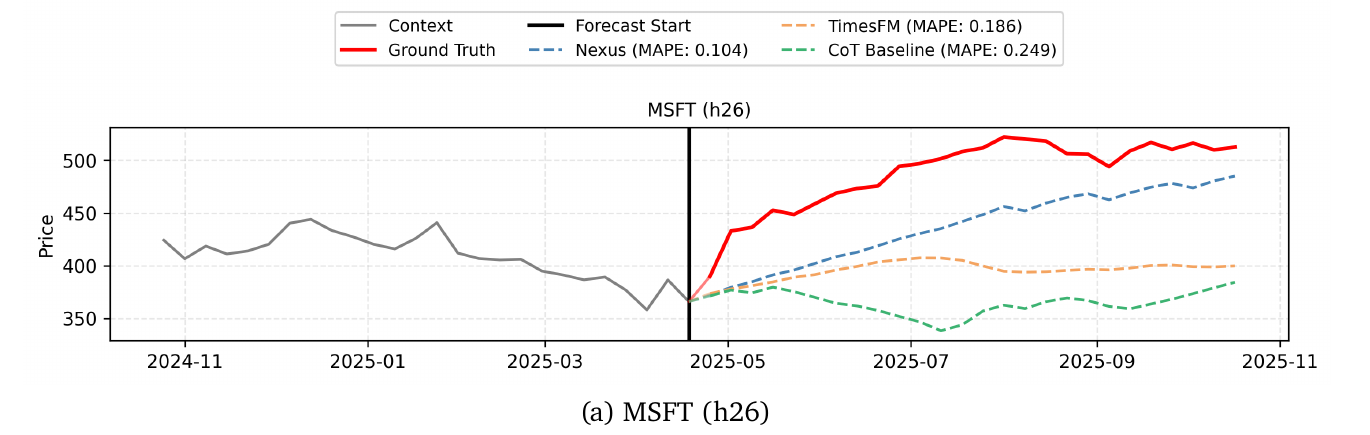
Nexus decomposes forecasting into specialised stages. It separates long run from short run fluctuations, folds in contextual information when it is available, and then synthesises a final prediction. The headline claim is striking: current language models have far stronger intrinsic forecasting ability than people assumed, and the thing that unlocks it is how you organise the numerical and contextual reasoning, not the raw size of the model.
Critically, Nexus lets the language model produce the numbers. It is a bet that an LLM, properly orchestrated, can be a competent forecaster in its own right. Tested on data that postdates the models’ knowledge cutoffs, it matches or beats specialised time series foundation models, and it does so while producing readable reasoning traces that explain each forecast.
Where my thesis disagrees
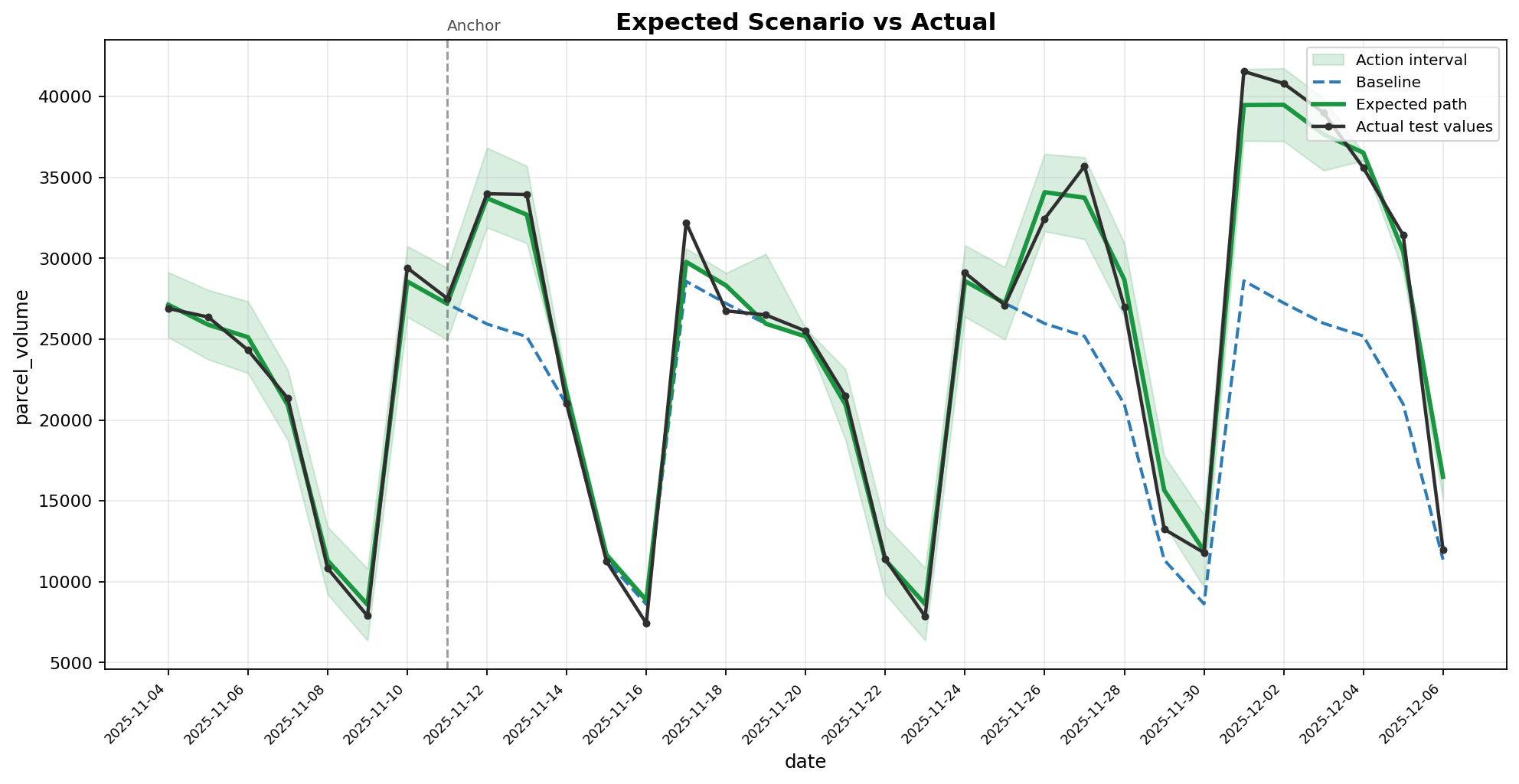
My thesis makes the opposite bet. The language model is never allowed to produce a number. Every numerical computation is delegated to a validated statistical model, and the LLM is confined to one job: reading natural language descriptions of events and translating them into calibrated adjustments to a baseline forecast.
The reason is a deliberate trade. By isolating the language model to the reasoning layer, any change in forecast quality can be attributed to its event reasoning rather than to its arithmetic, which lets me measure exactly what the LLM contributes. On event driven test windows the full system cut forecast error by 59% in a healthcare case and 66% in a logistics case, and it characterises when this reasoning is reliable, including a case where it cleanly fails when no grounding evidence exists.
Two bets, one direction
Nexus argues that forecasting is fundamentally an agentic reasoning problem, not just sequence modelling. I agree. We differ on how much numerical trust to place in the language model itself: Nexus hands it the calculator, I keep the calculator in validated statistical code and ask the model only to reason. Both point at the same future, where the text around a time series is treated as signal rather than discarded.